What “Intelligent” Actually Means for a Badminton Stringing Machine
A racket strung with only half a kilogram of variation across the bed can feel completely different to a player who relies on touch and power feedback. This is where the term “intelligent” gets concrete. In a crowded market of electric stringers, true intelligent badminton racket stringing machine manufacturers deliver more than a motorised pull — they deliver closed‑loop tension control, automated frame recognition, and data traceability that change how a stringer works.
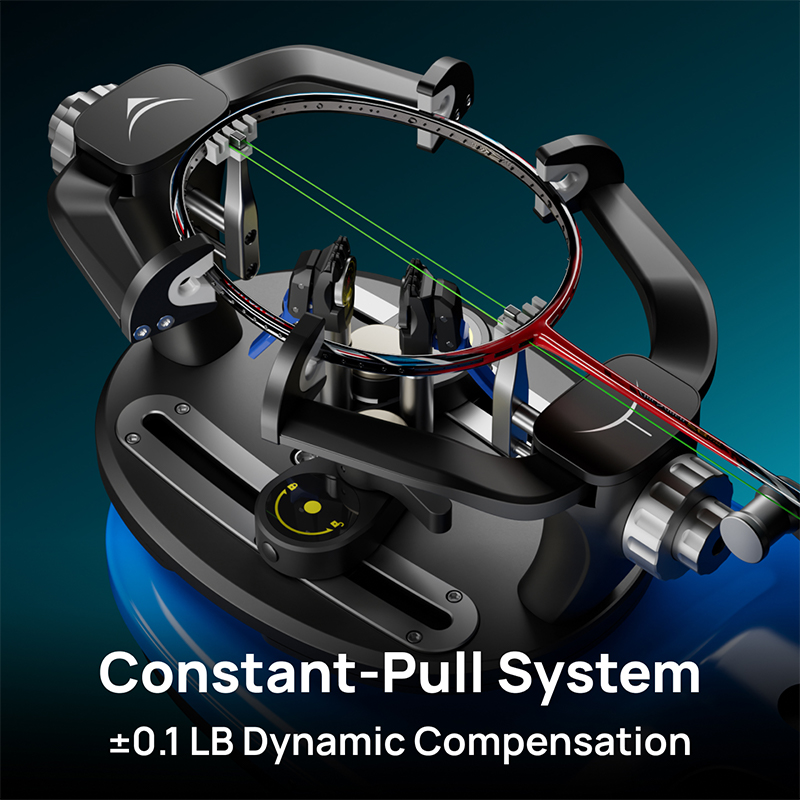
The practical distinction matters: an electric machine can still introduce tension drift if the pull mechanism overshoots or the clamp timing is inconsistent. Intelligent systems use optical sensors, real‑time load‑cell feedback, and adaptive motor algorithms to maintain set tension within a narrow tolerance — often ±0.1 kg — across every main and cross string. That level of repeatability is what separates a professional stringing service from a generic one.
Sensor Technology and Automated Clamping: The Real Differentiators
Not every machine with a screen qualifies as intelligent. The engineering beneath the cover tells the story. Established manufacturers invest in photoelectric sensors that monitor string grip and clamp release without operator interference, reducing the risk of slippage or frame stress. For example, a dual‑use design with height‑adjustable sensor arrays can automatically detect racket geometry and adjust pull angle to maintain a straight string path, a feature that directly influences tension consistency at the outer mains.
Automated clamping is another decisive factor. Machines that rely on manual clamp engagement require a highly skilled operator to avoid timing‑related tension losses. Intelligent models synchronise clamp engagement with the tension pull, releasing only after the head has returned to its home position. This sequence, governed by embedded firmware, delivers a tension‑loss variance below 0.2 kg across consecutive frames — a mark that top‑tier professional stringers rely on.
Buyers — whether running a commercial stringing service or equipping a national training centre — need a clear set of criteria. The table below translates broad claims into measurable expectations.
Core evaluation criteria for intelligent badminton racket stringing machine manufacturers
| Criterion |
Minimum Acceptable |
Preferred |
| Tension accuracy |
±0.5 kg |
±0.1 kg with load‑cell verification |
| Clamp timing |
Manual trigger |
Automatic sync with pull cycle |
| Frame protection |
Six‑point mounting |
Self‑centering supports with pressure sensors |
| Data logging |
None |
Stringbed stiffness report and job history export |
| Dual‑sport readiness |
Badminton only |
Quick‑change adapters for tennis and badminton |
| Firmware upgradability |
Static firmware |
OTA updates with calibration routines |
When a manufacturer’s specifications align with the right‑hand column, the machine can serve both elite players who notice minute tension shifts and high‑volume shops that need consistency across dozens of frames per day.
Manufacturing Depth and Quality Assurance
The gap between a prototype and a reliable production unit rests on factory‑level precision. Intelligent stringing machine manufacturers that operate their own assembly lines — rather than outsourcing to generic contract factories — can enforce tighter component sourcing, inline calibration protocols, and end‑of‑line test cycles. A production floor measured in tens of thousands of square metres is not a vanity metric; it typically houses CNC machining centres, load‑cell calibration stations, and climate‑controlled test rooms that guarantee every machine ships within published tolerances.
As we detail on our factory page, in‑house manufacturing allows for iterative improvements in sensor alignment and motor control boards without the lag of third‑party coordination. Additionally, quality certifications — such as ISO standards for electromechanical safety — provide an external benchmark that procurement managers can verify before issuing a purchase order.
Software Integration and Long‑Term Value
Hardware alone does not make a stringing machine intelligent. The operating system that runs on the LCD touch panel must expose real‑time tension graphs, stringing speed profiles, and cross‑string deflection data. Top‑tier manufacturers build platforms that connect to mobile apps or cloud‑based dashboards, turning each stringing job into a permanent record that a coach or equipment manager can reference months later.
For example, a machine that stores 500 job histories with racket model, string type, and ambient temperature lets a service centre benchmark its work against both manufacturer specs and historical consistency. This kind of data traceability — and the ability to receive over‑the‑air firmware upgrades that refine pull algorithms — ensures the equipment stays relevant for years, protecting the capital investment. Learn more about the R&D approach behind such systems on our about page.
The Bottom Line for Buyers
When evaluating intelligent badminton racket stringing machine manufacturers, focus on measurable output: tension repeatability across frames, automated clamp timing, frame protection logic, and the software ecosystem that supports daily operations. A manufacturer that combines deep electromechanical engineering with a robust production facility is far better placed to deliver the consistency that high‑level badminton demands. Those criteria move the selection process away from marketing brochures and toward the only metric that truly counts — the same racket, strung the same way, time after time.



 Español
 عربى
عربى


