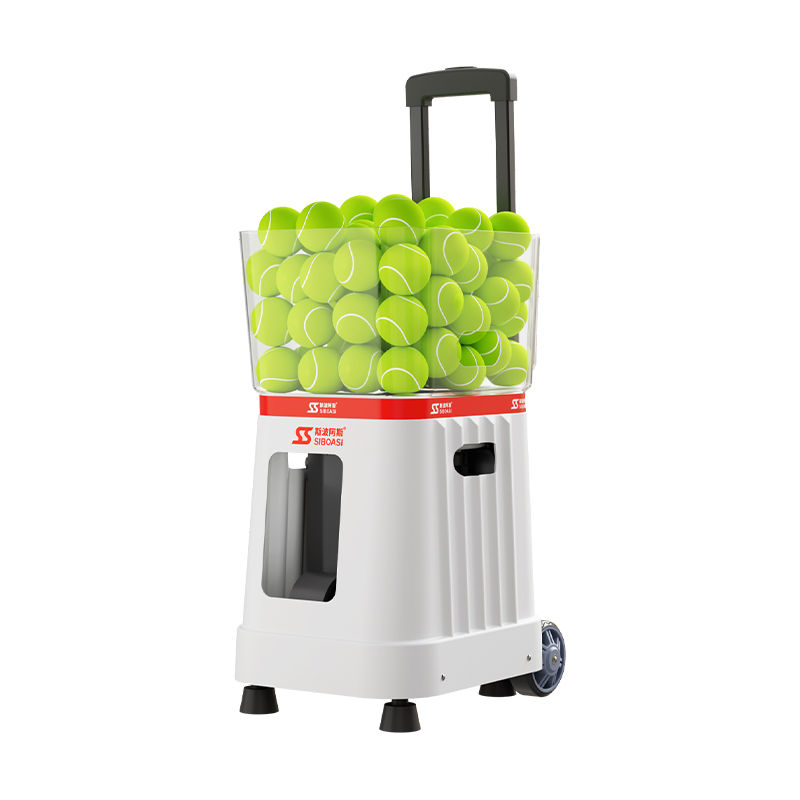
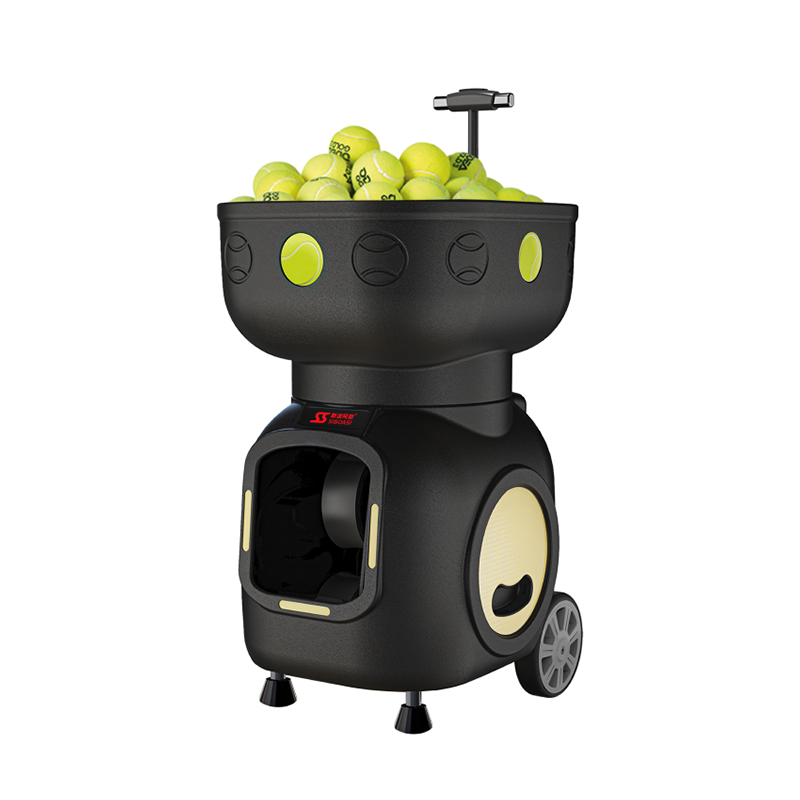
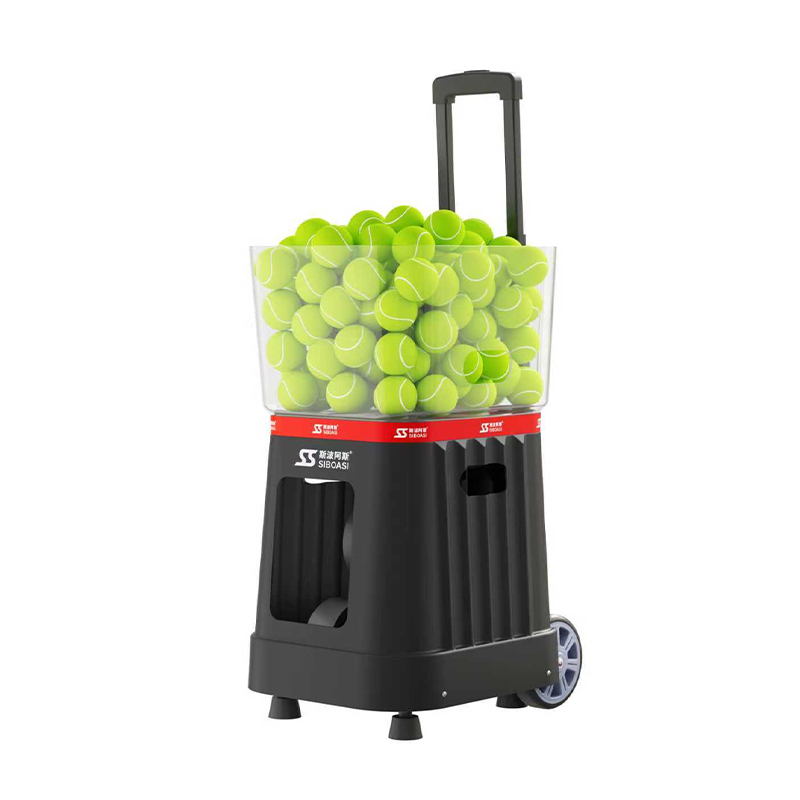
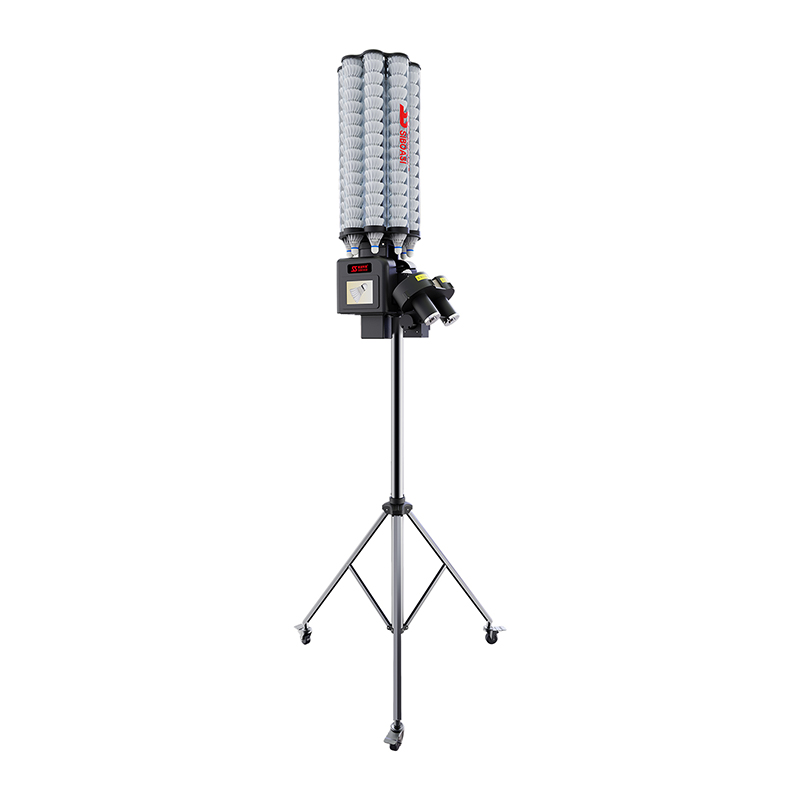
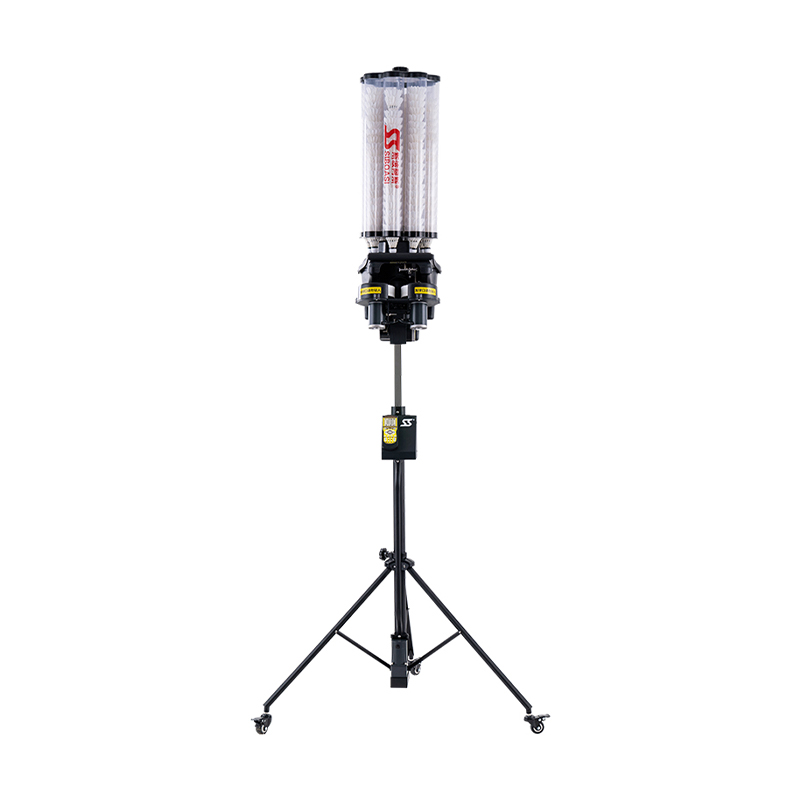
Walk onto almost any serious tennis court and you will eventually spot one: a compact machine humming at the baseline, firing balls over the net at a rhythm no human arm can match. That machine is a tennis ball launcher, and it has quietly become one of the most valuable training partners in the sport. It does not get tired, it does not judge a shanked forehand, and it will happily send the same ball to the same corner two hundred times in a row.
At Siboasi, we have been building intelligent ball machines since 2006, and we have watched the tennis ball launcher evolve from a simple spring-loaded feeder into a fully programmable training system. Modern units let a player dial in speed, spin, depth, and landing zones, then run the whole session from a phone. This guide walks through how these machines actually work, which features genuinely matter, and how to match a launcher to the way you play.
How a Tennis Ball Launcher Works
Most launchers on the market today belong to one of two mechanical families, and understanding the difference explains a lot about price, feel, and what each machine can teach you.
Air-pressure machines store balls in a sealed canister. When the machine powers on, an electric fan pulls outside air into that canister and builds pressure inside it. Each ball is then released into a barrel, where the stored pressure pushes it out toward the court. Speed is adjusted by changing the internal pressure, and the design produces a smooth, quiet delivery that many players find comfortable for high-volume feeding.
Wheel-based machines use two or more spinning rubber wheels. A ball is fed between the wheels and squeezed outward; the faster the wheels turn, the faster the ball leaves the machine. Because each wheel can spin at a different rate, wheel-based launchers can generate topspin and slice as well as flat shots, which makes them the more popular choice for serious tennis training.
Whichever mechanism sits inside the housing, most modern launchers share a similar set of parts:
- A ball hopper or canister that holds anywhere from 20 to 400 balls
- A feed mechanism that delivers one ball at a time at a set interval
- A throwing system, either rubber wheels or compressed air
- An oscillator that sweeps delivery across the court instead of repeating one line
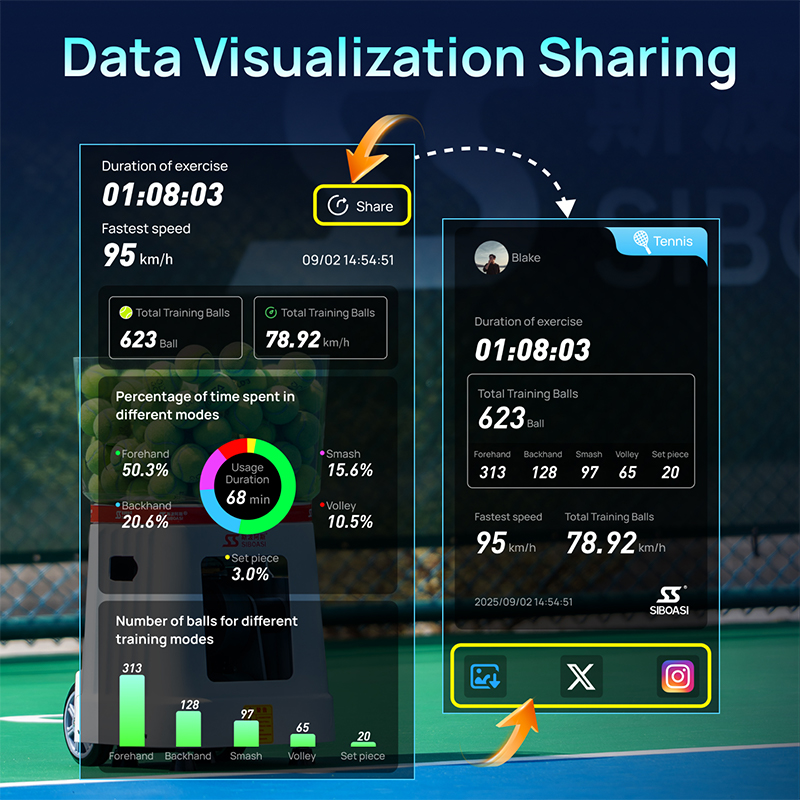
- A control unit that may be a physical panel, a handheld remote, a mobile app, or voice control
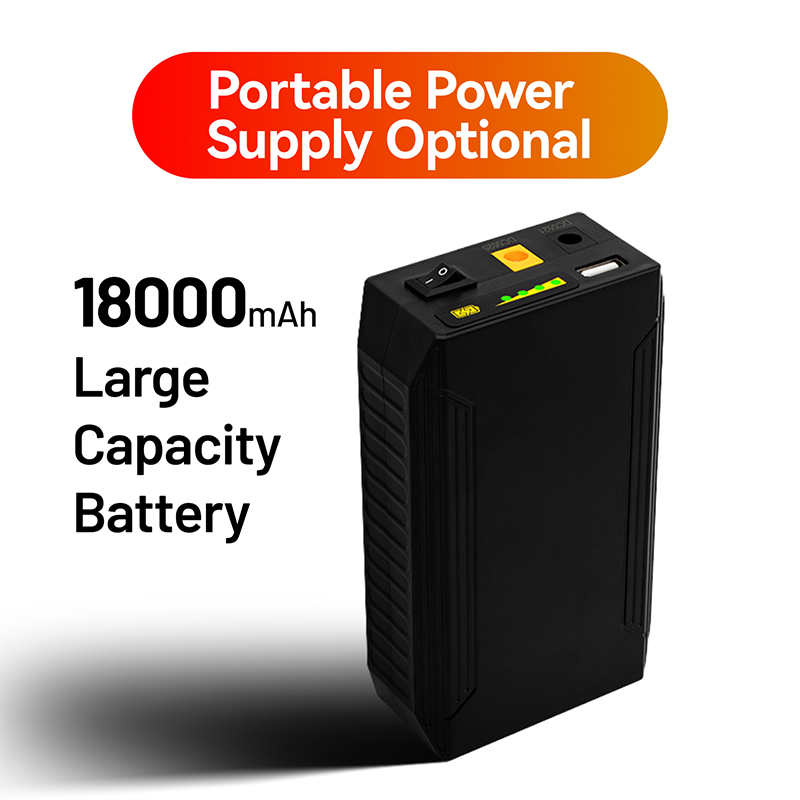
- A power source, usually mains electricity or a built-in rechargeable battery
Why a Launcher Belongs in a Training Plan
A hitting partner is wonderful, but a partner cannot deliver the same ball forty times without drifting. That consistency is exactly what a launcher does best, and it is why coaches keep one on court even when they have a full squad to work with.
- It repeats a single stroke pattern until the movement becomes automatic
- It pushes footwork with alternating wide and short balls
- It simulates a specific opponent's habits, such as heavy topspin to the backhand
- It keeps an entire group moving during a lesson instead of queuing behind one feeder
- It lets a solo player train on days when no partner is available
- It controls the pace of return-to-play work after an injury
The real value is not just volume. It is predictability. You can change one variable at a time and see exactly what happens to your contact point, your balance, or your recovery steps.
Features That Matter When Comparing Models
Specification sheets can be overwhelming, so it helps to know what each number actually changes on court. The table below translates the most common specifications into practical effects.
A quick comparison of the launcher features that change how a practice session actually feels.
| Feature |
What It Changes |
Who Benefits Most |
| Ball speed range |
How hard the ball arrives and how closely it mimics match pace |
Intermediate and advanced players |
| Landing-zone programming |
The number of repeatable targets you can drill in one sequence |
Coaches running structured sessions |
| Oscillation |
Whether balls alternate across the court or repeat one line |
Anyone training movement and recovery |
| Feed interval |
The rhythm between shots and how much recovery time you get |
Beginners and fitness-focused players |
| Ball capacity |
How long you can train before stopping to refill the hopper |
Groups, academies, and clubs |
| Control method |
Whether you adjust settings from a panel, remote, app, or voice |
Solo players and busy coaches |
Choosing a Launcher by Player Level
Beginners and Home Players
Players who are new to the game, or who train mostly on a nearby court, need simplicity above everything else. Too many settings on day one becomes a distraction from the actual stroke work. Our entry model, the T1, uses a single dependable speed setting with a sturdy build and controls that take seconds to learn. It is the kind of machine you wheel out, switch on, and start hitting against without reading a manual.
 T1 Tennis Ball Machine Beginner Basic Single-Speed ModelThe T1 Tennis Ball Machine is designed specifically for tennis beginners who need a reliable and straightforward training partner. With a fixed ball feed speed, it rem...View Product →
If most of your practice happens close to home, our home training setups are built around exactly that routine, with compact footprints and quick storage.
Intermediate Club Players
Once you can rally consistently, the limiting factor becomes variety rather than volume. The T2202A answers that with 21-zone precision drill programming and app control, so you can build a sequence that sends two balls to the forehand corner, one to the middle, and then a short ball you have to sprint for. Sessions stop being random and start having a shape you can measure yourself against.
 T2202A 21-Zone Precision Drill Programming APP-Enabled Tennis Ball Machine21-Zone Court Programming The T2202A allows users to program 21 distinct court landing positions into customized drill sequences. This programmability supports both ta...View Product →
Advanced Players, Teams, and Academies
At tournament level, training has to mirror match pressure. The T7 Pro adds voice control and a tactical edition designed for professional teams, with enough speed and spin range to reproduce the heaviest ball a player will realistically face. For an academy running several groups a day, that combination of durability and programmability is what keeps the schedule on track.
 T7Pro Voice-Control Tennis Ball Machine Professional Team & Tournament Tactical EditionThe T7Pro Voice-Control Tennis Ball Machine – Professional Team Tournament Tactical Edition is engineered specifically for professional tennis teams demanding precisio...View Product →
Teams and coaching centres that need a repeatable daily structure will find more ideas in our professional training solutions.
Drills You Can Run Tomorrow
You do not need a complicated plan to get value out of a launcher. Try one of these the next time you are on court:
- Set a moderate feed to the forehand corner and hit twenty cross-court forehands, focusing only on early preparation.
- Switch on oscillation with a wide spread and practise split-stepping on every single ball.
- Programme a short ball every fourth feed and attack it, then recover to the baseline.
- Increase the speed slightly and reduce the interval to simulate a hard-hitting opponent.
- Alternate two deep balls with one short ball to rehearse the transition between defence and attack.
- Finish with ten serves between feeding cycles so the arm stays sharp while you are tired.
Setup, Storage, and Everyday Care
A launcher is a long-term investment, and a little routine care keeps it performing season after season.
- Position the machine slightly off-centre so the feed angle mimics a real rally
- Wipe the throwing wheels and inspect the hopper every few sessions, especially on dusty outdoor courts
- Charge batteries fully before a long session rather than partway through one
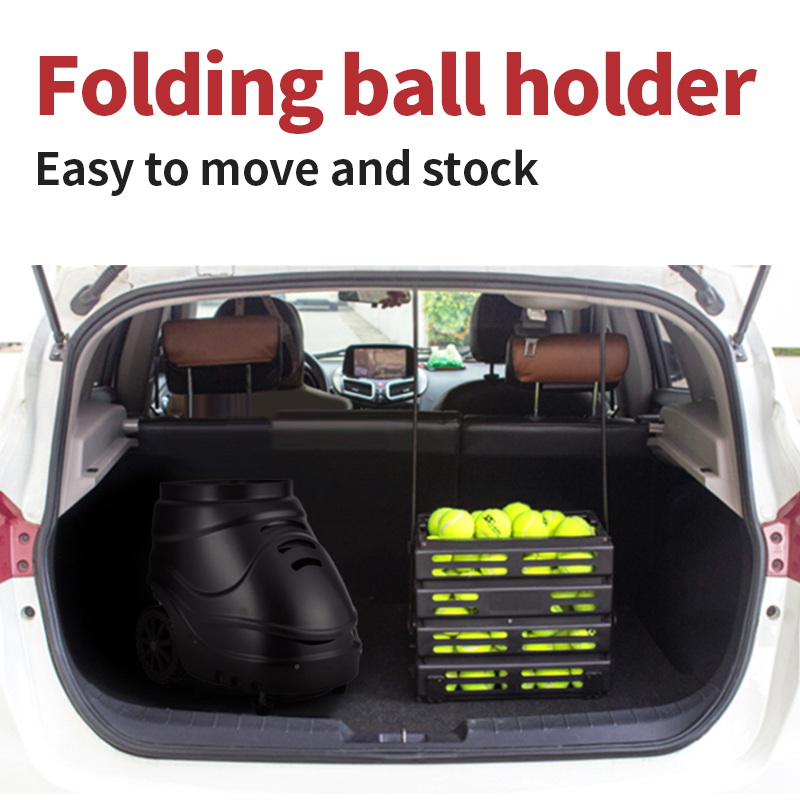
- Store the unit somewhere dry and cover it if the court has no shelter
- Check the manual for the correct ball type, since worn or wet balls feed inconsistently
Before You Buy: Quick Answers
These are the questions we hear most often from players and coaches choosing their first machine.
- How much space do I need? A standard singles court is plenty, and most launchers work well from the baseline or from a cart near the net.
- Can I use it indoors? Yes, though a lower speed range and softer balls suit a small hall far better.
- Do I need mains power? Not necessarily. Several models run on built-in batteries, which makes court-side setup much easier.
- Is a programmable machine worth it for one person? If you train alone regularly, landing-zone programming is usually the feature you will appreciate most.
A tennis ball launcher is ultimately a tool for turning good intentions into repetitions. The right machine for you is rarely the one with the longest specification list; it is the one you will actually switch on three times a week. Start with the shots you want to improve, choose the features that support those shots, and let the machine handle the rest.



 Español
 عربى